
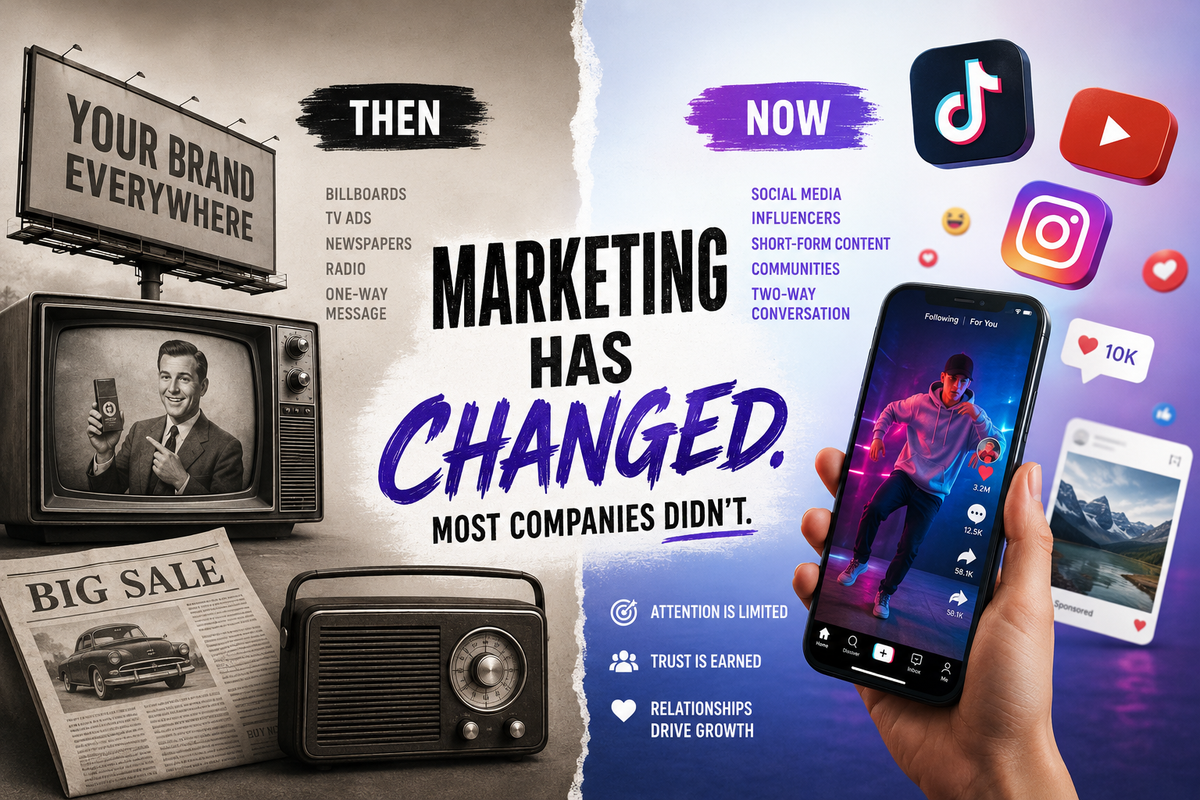
There was a time when marketing was simple.
A company could buy a television commercial, place a billboard beside a highway, run a newspaper advertisement, and instantly become recognizable to millions of people. Attention was centralized. Media was limited. Competition was manageable.
If a brand had enough money, it could dominate public attention.
That strategy worked for decades.
But the internet changed everything.
Today, people skip ads within seconds. Banner blindness is real. Email open rates continue to fall. Consumers scroll past sponsored content without even noticing it. Most advertisements are no longer competing against other advertisements.
They are competing against infinite entertainment.
And that changes the entire game.
Modern marketing is no longer about shouting louder than competitors.
It is about becoming impossible to ignore.
The Era of Mass Marketing
In the 1950s and 1960s, marketing operated very differently from today.
Consumers had limited sources of information:
- Television
- Radio
- Newspapers
- Magazines
That was it.
If a company appeared on national television, it automatically gained credibility and visibility. Brands like Coca-Cola became cultural icons not only because of their products, but because they mastered mass distribution of attention.
At that time, audiences were passive.
People consumed whatever media was placed in front of them. Companies controlled the narrative. Consumers had very little choice.
The relationship between brands and audiences was one directional:
Companies talked.
People listened.
For decades, this system worked perfectly.
Then the internet arrived.
And suddenly, audiences gained control.
The Internet Destroyed Traditional Attention
The rise of platforms like YouTube, Instagram, and TikTok fundamentally changed human behavior.
For the first time in history:
- Anyone could create content
- Anyone could build an audience
- Anyone could influence millions of people
Attention became decentralized.
Consumers no longer waited for brands to entertain them. Instead, they chose what they wanted to watch, when they wanted to watch it, and how long they wanted to engage with it.
This created a brutal new reality for companies:
Your brand is no longer competing only against your industry.
Your brand is competing against memes, creators, Netflix, notifications, short-form videos, and dopamine itself.
A productivity app is not only competing against other productivity apps.
It is competing against endless scrolling.
That is the real battlefield.
We Are Living in the Attention Economy
The most valuable resource in the modern internet is not oil.
It is attention.
Every company wants it. Every platform monetizes it. Every creator fights for it.
Human attention has become one of the most expensive commodities in the world.
The problem is that attention is now fragmented into thousands of directions simultaneously.
A single person might spend one hour switching between:
- TikTok
- YouTube Shorts
- Instagram Reels
- Discord
- Netflix
- Messages
- Notifications
Meanwhile, companies still try to market products using strategies designed for a completely different era.
That is why many modern advertisements fail.
Not because the products are bad.
But because the marketing feels outdated, artificial, and emotionally disconnected.
People No Longer Trust Brands Easily
One of the biggest shifts in modern marketing is trust.
Consumers today are more skeptical than ever.
They have seen:
- Fake promises
- Manipulated advertisements
- Corporate buzzwords
- Overproduced marketing campaigns
As a result, polished corporate messaging often feels less authentic than a random creator speaking directly to a camera.
This is why influencer marketing exploded.
A creator with a smartphone and personality can sometimes outperform a million-dollar advertising campaign.
Because modern consumers trust people more than corporations.
That changes how brands must communicate.
Today, audiences do not want perfect brands.
They want relatable brands.
Humor Became a Marketing Weapon
Traditional companies spent years trying to appear professional.
Internet culture changed that.
Now, some of the most successful brands on the internet deliberately act human, sarcastic, chaotic, and self-aware.
Take Duolingo as an example.
Instead of behaving like a traditional education company, they embraced meme culture. Their mascot became part of internet humor. Their social media strategy became entertaining enough that people voluntarily shared their marketing.
That is the key difference.
Old marketing interrupted entertainment.
Modern marketing becomes entertainment.
Another example is Ryanair.
Instead of pretending to be a luxury airline, they leaned into internet sarcasm and self-awareness. Their TikTok content often feels more like meme content than corporate advertising.
And it worked.
Because people remember personality.
Not corporate slogans.
The Death of “Corporate Safe” Marketing
For years, companies believed the safest strategy was to avoid personality.
Everything became overly polished:
- Generic taglines
- Stock photos
- Artificial corporate language
- Emotionless campaigns
The result?
Every brand started sounding identical.
Modern audiences instantly recognize manufactured marketing.
And they ignore it.
Internet culture rewards authenticity, speed, personality, and emotional connection. People want brands that feel alive.
Today, a funny tweet can outperform an expensive advertising campaign.
A relatable short video can generate more engagement than a cinematic commercial.
A founder speaking honestly can build more trust than a carefully scripted press release.
The internet changed what “professional” means.
Professional no longer means robotic.
Community Is More Powerful Than Advertising
The strongest modern brands do not simply sell products.
They build communities.
Apple is one of the best examples of this.
People do not buy Apple products only because of specifications.
They buy identity.
They buy belonging.
They buy emotional attachment to a brand ecosystem.
That emotional connection is incredibly powerful.
The same thing is happening across startups, gaming communities, creator platforms, and modern SaaS products.
Users want to feel involved.
They want interaction, culture, memes, inside jokes, transparency, and human connection.
The future belongs to brands that understand community psychology.
Not just advertising psychology.
Why Many Companies Still Fail to Adapt
Even in 2026, many businesses continue using outdated marketing logic.
They believe:
More ads = more growth.
But modern audiences are overwhelmed with advertisements every second of the day.
More noise does not automatically create more attention.
In many cases, it creates more irritation.
Consumers are no longer impressed by companies simply because they spend money on marketing.
They care about:
- Authenticity
- Entertainment
- Transparency
- Relatability
- Storytelling
- Human connection
The companies still relying entirely on old strategies are slowly becoming invisible online.
Not because they lack resources.
But because they fail to understand modern behavior.
Modern Marketing Is Psychological
Marketing today is no longer just promotion.
It is psychology.
It is understanding how humans react emotionally inside an internet-driven world filled with endless stimulation.
Modern marketing is about:
- Storytelling
- Identity
- Humor
- Internet culture
- Community
- Short-form attention
- Emotional triggers
- Human behavior
The brands that win are not always the biggest.
Sometimes they are simply the most relatable.
The Future of Marketing
The future of marketing will belong to companies that feel human.
Brands that understand culture will outperform brands that only understand advertising.
The internet rewarded corporations for decades.
Now it rewards personalities.
This does not mean professionalism is dead.
It means emotional connection matters more than corporate perfection.
Because people remember how a brand made them feel.
Not how polished the advertisement looked.
Final Thoughts
Marketing has changed more in the last decade than in the previous fifty years combined.
The old system was built around interruption.
The new system is built around attention.
And attention today must be earned.
Not forced.
The companies that continue using outdated marketing strategies are not only losing customers.
They are losing relevance.
In 2026, the biggest marketing advantage is no longer having the loudest voice.
It is becoming the brand people actually want to pay attention to.